I typed the following response to a thread at Sawmill Creek only to find out that I can't post there any more. (Do I need a membership?) If you're reading this and can post there, then you are welcome to send him here. No block quotes from here to there.
Tim,
As stated, your main problem is that your sole is out of flat along its length. Your secondary problem is that the previous owner has convinced you that the way the profile of the iron currently matches the sole is good enough. It's not (likely).
First, 100% of un-tuned antique planes have a high spot behind their mouth. Some of them have a slight high spot and can be used, but could work better. Others are completely out of flat and don't work at all. It sounds like you have a couple of planes that fall into this latter category. (I say 100% as a joke, but I really haven't seen one that doesn't.)
That being said, the first step of tuning any antique should be to flatten the sole. Don't purchase a plane whose sole you can't flatten. I use hollows for rounds, rounds for hollows, and hollows & rounds for complex profiles. Side beads? You'll need a mother plane or an appropriately sized core router bit and router table to flatten the sole.
Side beads have a reputation as being a good plane for a beginner to start. I disagree with that mainly for this reason: flattening the sole is impossible without the correct set-up and you are probably not in possession of the correct set-up. Additionally, sharpening 180 degrees of a profile isn't the easiest place to start. Your large profiles will make both of these easier, however.
As an added bonus to flattening your sole first, you'll find matching the iron to the sole easier once the sole is flat. 1. Once flat, you won't be looking at the horizon of the bed over the mouth as you site down the sole, thinking that you're seeing the cutting edge. 2. you won't have a patina on the sole that is the same color as the silhouette of the cutting edge.
Steps to tuning antiques:
1. Avoid planes that have an ill-fitting wedge. (Cars and hand planes are similar in that any of either can be made to work flawlessly. Many of both are not worth the time, effort and expense. The fit of the wedge is a glimpse at the maker's skill and/or plane's life.)
2. Flatten sole
3. Fix mouth
4. visual inspection that iron is bedded
5. sharpen
6. re-bed iron if the plane chatters
There's other things that can go wrong. For instance, some of those mint antiques were never used because they didn't work on the day they left the prison in which they were made. These can be avoided by skipping over ill-fitting wedges. There are integral faults in some planes from EVERY era.
Finally, I start snipes bills by striking a line with a marking gauge. I start side beads upon a square corner. You'll probably start yours with a running start.
Good luck!
If you have any questions then you can post them in my comments.

Monday, March 23, 2020

Thursday, March 5, 2020
No Further Purchase Necessary: 10-Year Anniversary Raffle
The NWA Woodworkers' Showcase is the anniversary date of my business each year. The 2010 show was the first time that I actively pursued customers. This year, March 28-29, 2020, marks the 10-year Anniversary of my plane-making business.
10 years!
10 years of people willing to listen to me at a shows. 10 years of people reading what I write and watching what I make. Most importantly, 10 years of little-known people willing to make substantial investments in wooden moulding planes, trusted to some guy they read about on the internet or met briefly at a show.

I've been thinking of ways to celebrate this milestone and I think I came up with a good one:

To reward those of you that have rewarded me with your patronage, I will be randomly choosing one of you many people that have previously purchased or have already placed orders to purchase plane(s) directly from me.
Each plane that each customer ordered will be a single entry to win a prize. There are 3,619 entries.
To be clear, everybody that took delivery of one plane from me already has one entry. Everybody that currently has a plane on backorder has an entry. If you ordered 18 planes then you have 18 entries.
(No further entries will be accepted for this contest, but further orders are always encouraged.)
What will you win? I have been thinking about that, too. I think I also came up with a great prize.
I don't want to thank only the people who have purchased planes from me. I also want to thank the businesses that have played a remarkable role in my existence. So the winner can choose a $500 gift certificate from one of the following companies:
Acanthus Workshop
Benchcrafted
Connecticut Valley School of Woodworking
The Furniture Institute of Massachusetts
Lie-Nielsen Toolworks
Lost Art Press/Crucible
Port Townsend School of Woodworking
Old Street Tool
These companies are aware that this contest is happening, but they aren't really participating. This means that if you win and choose company X then you'll tell me that you want the gift certificate for company X and I'll buy it. Don't contact company X to claim it. Do not burden them as I have.
If you win and you want the gift certificate broken up into 2, then I'll do that. I'll prefer not buying 6 different gift certificates from 6 different places, but whatever works for you...
As for the raffle, I'll be using "The Randomizer" like I have in raffles of the past. There will be four shots (rounds), selecting the digits A,BCD. The four shots will happen sequentially on different days, with digit A being first. The winning digit will have the most shot pellets inside or upon the border of their circle. A tie will be broken by the shot that is closest to the center point, established by the compass. The second tie-breaker is the second closest pellet to the center point, and so on.

(Note: The '3' circle is intentionally smaller.)
What's your digit? The order in which I delivered each plane will be your digit. If you ordered 18 planes at once then you have 18 sequential entries. If you ordered 10 planes over the course of 5 orders then you'll have 5 blocks of 2. Thirty planes on backorder means 30 entries (prize to be delivered upon you taking the delivery of the order).
All issues shall be decided by me. In the event that I can't contact the winner (moved, changed email address, AND changed phone number or death, etc.), then I will go to the second highest count for the fourth digit. In the event that the winning customer also happens to be an eligible company (numbers 0001-0018 are, for instance), then they still win. If they insist on declining, which I will encourage they do not, then we'll figure it out.
Finally, I will suggest the winner buy something for which they haven't yet budgeted. Take a class you haven't intended to take or buy a tool/book for which you aren't currently saving. I hope you treat the prize as a windfall for you and the business you choose.
Results of each round will be posted on my instagram feed, @msbickford. Please free to audit the contest results at the NWA Woodworkers' Showcase at the end of the month. I'll be there, I'll bring the spent targets, I'll bring my planes for you to try and a piece to enter in the showcase.

(Also, feel free to see vote for my piece for 'fan favorite' at this year's NWA Showcase)

(Just be sure you're voting for the correct one)
Note: If the winner is not in the United States and the specific company they choose does not have a location in your country (which they won't) then I'll have to purchase the tool, books, etc. and send it to you. I'll prefer not to deal with third-parties. Shipping and taxes will be your responsibility if the final total number exceeds the $500.
Note 2: I will ask that you do not contact me requesting your number(s). I don't have the time to respond to the 600+ customers. I will publish the date range of delivery (likely on Instagram, @msbickford) that remains in play after each round.
Note 3: If you purchased planes I made from eBay or an antique tool seller, then you are not in the running, unfortunately. Let's just hope the person who sold the planes that you have doesn't win.
NOTE 4: THANK YOU!
Friday, January 11, 2019
And the Winner Is...

#118, #118, #118!!!
I am always fascinated that people share my fascinations. I thank everybody for reading and responding. I'll do this again in the future. I hope to hold your attention. Thank you.
#118 had 5 shots inside. There were a few others that had 4.


Now, to go pick up a customs form because this plane is going to the Netherlands...
Sunday, January 6, 2019
Rabbet Raffle Round 1 Results
Who will win this X-out Rabbet plane?

The selection committee has spoken!

The lucky many (50) who will enter the final round are listed below.

Check to see if your number advanced and stay tuned...
You can see my previous post to find out which number was assigned to you.

The selection committee has spoken!

The lucky many (50) who will enter the final round are listed below.

Check to see if your number advanced and stay tuned...
You can see my previous post to find out which number was assigned to you.
Saturday, January 5, 2019
Raffle to Win a Rabbet Plane
The entry period to win a rabbet plane is closed. I appreciate all readers who entered and even those hundreds of you who didn't (read far enough here or here).
Here are the rules:
My son will randomly choose the lucky few/several/many to make it to round 2 with The Randomizer. He will shoot one round of shot at the target below. Anybody who has any portion of their circle pierced will make it to the final round to be held a few days after the first. One round nicking a circle equals 3 in the center. I am the final arbiter regarding any issues, but there won't be any.

The numbers have been distributed in the order in which you responded to my request. The first person to send an email is #1, the last person is #173.
You may find your number in the following images. The list is alphabetical based upon the email address with which you responded. I put a lot of asterisks over a large part of each person's address to keep this anonymous. Please let me know if you have any questions, but let's keep these minimal and double check your number against your known address.


Here are the rules:
My son will randomly choose the lucky few/several/many to make it to round 2 with The Randomizer. He will shoot one round of shot at the target below. Anybody who has any portion of their circle pierced will make it to the final round to be held a few days after the first. One round nicking a circle equals 3 in the center. I am the final arbiter regarding any issues, but there won't be any.

The numbers have been distributed in the order in which you responded to my request. The first person to send an email is #1, the last person is #173.
You may find your number in the following images. The list is alphabetical based upon the email address with which you responded. I put a lot of asterisks over a large part of each person's address to keep this anonymous. Please let me know if you have any questions, but let's keep these minimal and double check your number against your known address.


Unfortunately, it's raining today and I don't want to deal with running ink. We will have The Randomizer choose the winner ASAP. Tomorrow looks like it will be the day. I will post the full video upon completion immediately on my Instagram account: @msbickford. I'll later post the names/numbers of those who made it to round 2, along with the full video, here.
Again, there are 2 rounds this year which is different than the one of last. (I have fun with the contest and want to prolong it. I thank you each for humoring me.)
Saturday, December 29, 2018
Approaching the Limits of My Pay-Grade: Roman Vs. Grecian Profiles
The pursuit of my woodworking hobby has generally consisted of seeing a piece of furniture and wondering a) if I could build it and b) what it will look like once I do. Basically, my house is filling with self-indulgent endeavors that are totally unrelated to my family's needs (think wife).
These pursuits are actually how I was originally attracted to hollows and rounds. With hollows and rounds I am limited by my skill but not by what bits I have in my drawers or Freud has in their catalogues. (i.e. I've started a new project and the very last thing I'll consider are the intricately specific profiles. I know I can make them, it's just not a concern.)
I put up a post on my blog yesterday regarding a custom moulding plane I was commissioned to make. This profile is a "Grecian" profile vs. a "Roman."

Sometimes I wish I wanted to learn about the reigning empires, major players, and world affecting events of the period that may have led to the evolution that greatly affected my Wednesday of this past week. In fact, maybe the proper thing to do is go read about the subject for a few hours, make broad statements that I cannot cite, and then hope a few specific people won't read my blog. This will then certainly dazzle you with my Wikipedian-like "knowledge," right? Well, I won't.
I'll just quickly make a broad generalization about the the difference between Roman and Grecian profiles that may define a few terms I reference on occasion: Roman profiles are made out of circle segments and Grecian profiles are made out of elliptical segments.

Hollows and rounds allow me to copy both. I know I can make the plane I was commissioned to make. Additionally, I can make the profiles I may want to make in the future: circular vs. elliptical, Grecian vs. Roman, and William & Mary vs. Chippendale vs. Becksvoortian (AKA Shaker, AKA no moulding planes).
Note 1: I know and care more than may let on here.
Note 2: Please send a single email to matt@msbickford.com with the subject of "Raffle" to enter to win an 'X-out' 7/8" rabbet plane. I did a contest like this last year. I go out of my way to keep the winner to being a reader. If the contest gets posted on Instagram, Twitter, Tinder, etc. then I'm going to cancel or postpone it. I don't want the publicity, likes or follows. (You don't even have to sign up for my mailing list, nor will you be put on it.) Don't decrease your chances of winning! Like last year, the contest winner will be chosen randomly in an ultra-transparent manner. This won't be me giving the plane to the person with the highest Iprofile. Like last year, I will ship this plane anywhere that USPS will deliver, their rules/relationships not mine. US and Canada? Sure. Germany and Australia? Definitely. The Congo? Probably not, I don't know. But you're probably fine to enter. The specific rules will be defined once the entry period is over. I am the final arbiter. Entries must be made before 23:59 EST on 1/4/19. The plane will work perfectly, I just don't like the piece of wood. If you win and you've already purchased a rabbet plane directly from me then I'll find something else for you.
These pursuits are actually how I was originally attracted to hollows and rounds. With hollows and rounds I am limited by my skill but not by what bits I have in my drawers or Freud has in their catalogues. (i.e. I've started a new project and the very last thing I'll consider are the intricately specific profiles. I know I can make them, it's just not a concern.)
I put up a post on my blog yesterday regarding a custom moulding plane I was commissioned to make. This profile is a "Grecian" profile vs. a "Roman."

Roman ogee on the Left, Grecian on the Right
Sometimes I wish I wanted to learn about the reigning empires, major players, and world affecting events of the period that may have led to the evolution that greatly affected my Wednesday of this past week. In fact, maybe the proper thing to do is go read about the subject for a few hours, make broad statements that I cannot cite, and then hope a few specific people won't read my blog. This will then certainly dazzle you with my Wikipedian-like "knowledge," right? Well, I won't.
I'll just quickly make a broad generalization about the the difference between Roman and Grecian profiles that may define a few terms I reference on occasion: Roman profiles are made out of circle segments and Grecian profiles are made out of elliptical segments.

Again, Roman on the Left, Grecian on the Right
Hollows and rounds allow me to copy both. I know I can make the plane I was commissioned to make. Additionally, I can make the profiles I may want to make in the future: circular vs. elliptical, Grecian vs. Roman, and William & Mary vs. Chippendale vs. Becksvoortian (AKA Shaker, AKA no moulding planes).
Note 1: I know and care more than may let on here.
Note 2: Please send a single email to matt@msbickford.com with the subject of "Raffle" to enter to win an 'X-out' 7/8" rabbet plane. I did a contest like this last year. I go out of my way to keep the winner to being a reader. If the contest gets posted on Instagram, Twitter, Tinder, etc. then I'm going to cancel or postpone it. I don't want the publicity, likes or follows. (You don't even have to sign up for my mailing list, nor will you be put on it.) Don't decrease your chances of winning! Like last year, the contest winner will be chosen randomly in an ultra-transparent manner. This won't be me giving the plane to the person with the highest Iprofile. Like last year, I will ship this plane anywhere that USPS will deliver, their rules/relationships not mine. US and Canada? Sure. Germany and Australia? Definitely. The Congo? Probably not, I don't know. But you're probably fine to enter. The specific rules will be defined once the entry period is over. I am the final arbiter. Entries must be made before 23:59 EST on 1/4/19. The plane will work perfectly, I just don't like the piece of wood. If you win and you've already purchased a rabbet plane directly from me then I'll find something else for you.
Thursday, December 27, 2018
Creating Custom Moulding Planes
I constantly disappoint two groups of woodworkers, one of which is the 'hand-tool only' crowd.


Many people assume that I must be part of this wild group due to my making of moulding planes for a living. These crazies (said with affection) are often shocked and disappointed when they find out that I am not entirely one of them. I have a router and I like my router. (Fun Fact 1: my router was the first thing I ordered off of Amazon 15 years ago. I paid $279 + shipping in '03 and I could now get the same kit for $263 with shipping included.)
If I need to thickness a board less than 12" then I'm headed to my planer 10 out of 10 times. However, with hand planes I can thickness a face that is more than 12" and, on those rare occasions, even more than 30". Bench planes offer me the ability to flatten and thickness any width, not limited by fences, etc. (Fun Fact 2: my planer was part of my second order from Amazon way back then. I paid $449 and the same model is currently $599.)
(Fun Fact 3: you don't care about my Amazon history, so I'll stop.)
Hand tools afford me this desirable idea of infinity: whether flat surfaces done with planes vs. machines, dovetails done by hand vs. jig, even the tenons upon a curved surface to adjoin with a crest rail of a Queen Anne chair.

INFINITY!
Hollows and rounds offer me the same infinite number of possibilities with moulding profiles as many hand tools do with other aspects of this craft. With my selection of hollows and rounds I can essentially make any moulding profile that happens along a straight length.


On occasion, I am requested to make custom, dedicated planes. In these instances I will need to manufacture 10" of a single profile that will be the sole. I will need to make this short moulding only one time.

I am still able to make these single planes for nearly the same price because I already have the proper tooling to make an infinite number of profiles: Hollows & Rounds.

(Metric measurements not included, but I can get close.)
Hollows and rounds fit perfectly into my workshop because I make small amounts of profiles that are determined by you, my customers. In my shop I use hollows and rounds to make the soles of custom planes, remove machine marks from standard planes, and to create the seemingly rare project (see above).
Hollows and rounds will allow you to comfortably make small amounts of highly specific profiles quickly and efficiently, whether it's for 10" of an exacting plane, a piece of reproduction furniture, or something entirely your own.


(The elliptical segments of this plane's sole was executed with four profiled planes #2 Hollow/Round and #3 Hollow/Round, neither of which are recommended for a first-timer)

Talking about (intentionally) softened corners, Chuck Bender wrote a fascinating blog regarding extremely sharp details on his blog the other day. Check it out.
disclaimer: Chuck is one of the three people responsible for getting me into this professional pursuit. I will be teaching at Chuck's mid-2019. I have a working relationship with him, but not Amazon.

Please send an email to matt@msbickford.com with the subject of "Raffle" to enter to win an X-out 7/8" rabbet plane. I did a contest like this last year. I go out of my way to keep the winner to being a reader. If the contest gets posted on Instagram, Twitter, Tinder, etc. then I'm going to cancel or postpone it. I don't want the publicity, likes or follows. (You don't even have to sign up for my mailing list, nor will you be put on it.) Don't decrease your chances of winning! Like last year, the contest winner will be chosen randomly in an ultra-transparent manner. This won't be me giving the plane to the person with the highest Iprofile. Like last year, I will ship this plane anywhere that USPS will deliver, their rules/relationships not mine. US and Canada? Sure. Germany and Australia? Definitely. The Congo? Probably not, I don't know. But you're probably fine to enter. The specific rules will be defined once the entry period is over. I am the final arbiter. Entries must be made before 23:59 EST on 1/4/19. The plane will work perfectly, I just don't like the piece of wood. If you win and you've already purchased a rabbet plane directly from me then I'll find something else for you.
Tuesday, December 18, 2018
Tuning a Rabbet Plane
All planes eventually go out of flat, both wood and metal.
Metal planes take a long time to distort and also take a long time to fix. Wooden planes go out of flat seasonally and are a one-minute fix.
In this post we will address tuning a wooden rabbet plane.

How do you know when a plane's sole is no longer adequately flat?
The first sign of a plane's sole no longer being flat will proceed in this manner: You set the plane to take a predictable shaving, but it does not. You then blame yourself and your inadequacies, only to set the plane to take a slightly more aggressive shaving. Then the plane only removes wood from the first and last 1/2 inch while still underperforming your expectations. You continue with this process, constantly setting it more aggressively and still being unimpressed with the not performing plane...
Eventually, you again set the plane to take a slightly more aggressive pass and your plane is taking a heavy, aggressive, and uncontrollable shaving throughout.
At this point you know that your expectations were originally correct and your plane's sole needs to be addressed.
How do you address the sole? Do not fear, wooden planes are easy:
Metal planes take a long time to distort and also take a long time to fix. Wooden planes go out of flat seasonally and are a one-minute fix.
In this post we will address tuning a wooden rabbet plane.

How do you know when a plane's sole is no longer adequately flat?
The first sign of a plane's sole no longer being flat will proceed in this manner: You set the plane to take a predictable shaving, but it does not. You then blame yourself and your inadequacies, only to set the plane to take a slightly more aggressive shaving. Then the plane only removes wood from the first and last 1/2 inch while still underperforming your expectations. You continue with this process, constantly setting it more aggressively and still being unimpressed with the not performing plane...
Eventually, you again set the plane to take a slightly more aggressive pass and your plane is taking a heavy, aggressive, and uncontrollable shaving throughout.
At this point you know that your expectations were originally correct and your plane's sole needs to be addressed.
How do you address the sole? Do not fear, wooden planes are easy:
Now throw some wax onto the sole and get back to work!
(Anybody that has a boxed rabbet plane shall spin the plane around and start working back to front once taking shavings in front of the mouth, otherwise you will be working against short grain and will chip out the mouth.)
Note: I will be posting instructions to win an 'X-out' plane in the coming day(s)/week(s). I go out of my way to keep the winner as being a current blog reader and 'in-house.' If you've made it this far into the text then I'll encourage you to keep reading my upcoming blogs, knowing that any publicity you give this future contest will ultimately reduce your chances of winning and my desire to pay my readers with these contests. I am, intentionally, not striving to increase my social media exposure. So, let us keep this quiet, or I will cancel the upcoming contest.
Saturday, December 15, 2018
Making Another Picture Frame with Hollows and Rounds (Actually, Just Hollows Here)
I will choose to keep this post quick because time is precious at this point of each year. Christmas presents must be made, after all. (This frame was made several years ago.)
This frame starts with material that is 1 3/16" wide


Like every profile made with hollows and rounds, we will start with a series of rabbets...

...and chamfers to remove waste and guide the profiled planes.

Step 3: #6 Hollow to make a full 180 degrees of an arc.

Step 5: #4 Hollow

Step 5 and 6: #2 Hollow

Finally, squash the top profile in Step 7: #10 Hollow

Picture frame profiles often look strange to us furniture people, but...

...they always come together once mitered, however.


For the record, I spent 00:20:10 with the profiled planes here, much of which was battling my previous workbench, Big Pink. I had it on videotape but couldn't bring myself to post it.
Note: I will be posting instructions to win an 'X-out' plane in the coming day(s)/week(s). I go out of my way to keep the winner as being a current blog reader, in-house. If you've made it this far into the text then I'll encourage you to keep reading my upcoming blogs, knowing that any publicity you give this future contest will ultimately reduce your chances of winning and my desire to pay my readers. I am, intentionally, not striving to increase my social media exposure. So, let us keep this quiet, or I will cancel the upcoming contest.
Thursday, November 29, 2018
An Introduction to Ovular and Elliptical Shapes with Hollows and Rounds
(The gist of this post was originally posted in December, 2010. Changes have been made.)
The holidays are coming up. I am (was) conveniently making a few picture frames as gifts. The presents are technically what's inside the frame, but those subjects are not the purpose of these posts.

I am often asked what pair of hollows and rounds a woodworker should start with. The answer, like most things, is that "it depends." I imagine that the 4s, 6s and 8swill have their place in everybody's work (radii of 4/16, 6/16 and 8/16, respectively). This advise, of course, doesn't help somebody that's looking for only one pair.
My recommendation for getting started is as follows: if you want one pair of hollows and rounds then pick an ogee that you like and I'll help you pick a pair to make it. (Fortunately, that same pair will likely fit into your shop well.)

If, however, you have the option, then get two pairs. With a second pair you will be able to make much more than twice as much than what is photographed above. You'll be able to make exponentially more profiles, in fact. You will be able to make all of the same profiles above, but in varying sizes.


Additionally, you'll be able to introduce ovular shapes by using two rounds or two hollows together, which is actually the subject of this post.


It is at this stage, having multiple sizes, that you will truly be able to recognize the versatility that these planes both allow and encourage. Get the 4s and 8s or the 6s and 10s and you'll be able to make scores of complimentary profiles. (Will you want 5s or 16s next? Rest assured that you will know.)
With ovular shapes, all planes are still being guided by the rabbets and chamfers previously touched upon. Steering them is not freehand, but at times it will feel like it is if you do not have a proper strategy.

Rabbets and chamfers will guide these planes in that same manner we have touched upon before.


#6 round followed by #10 round.


Chamfer with rabbet plane

#6 hollow followed by #10 hollow

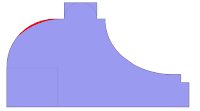
Finally use a rabbet plane for the chamfer followed by #2 hollow.


Look at the result 1-2 passes from completion below.

These picture frame profiles often look a little weird to my eyes (see above). Once they're mitered they are pretty complimentary (see below).

Ovular shapes are seemingly more difficult to lay out at first because it is not always obvious where the necessary guiding rabbets belong. The process is not apparently straight forward. Try a couple picture frames like this and you'll know your error(s) about 20% of the way through. Ultimately, know that you don't need perfect results with either your practice pieces/Christmas presents because you'll be getting socks or Tabasco Sauce in return, which is ideal.

P.S. It may feel like we're jumping all over the place. By seeing more complex profiles you'll start to piece the generic process together on your own. We'll get to the basics in the coming weeks and the basic process will then be evident.
Just think about the following: How do the rabbets act as depth gauges? How do the planes, themselves, act as depth gauges?
The holidays are coming up. I am (was) conveniently making a few picture frames as gifts. The presents are technically what's inside the frame, but those subjects are not the purpose of these posts.

I am often asked what pair of hollows and rounds a woodworker should start with. The answer, like most things, is that "it depends." I imagine that the 4s, 6s and 8swill have their place in everybody's work (radii of 4/16, 6/16 and 8/16, respectively). This advise, of course, doesn't help somebody that's looking for only one pair.
My recommendation for getting started is as follows: if you want one pair of hollows and rounds then pick an ogee that you like and I'll help you pick a pair to make it. (Fortunately, that same pair will likely fit into your shop well.)

These 30 profiles were all made with the same two planes, a single pair of 6s.
If, however, you have the option, then get two pairs. With a second pair you will be able to make much more than twice as much than what is photographed above. You'll be able to make exponentially more profiles, in fact. You will be able to make all of the same profiles above, but in varying sizes.

These four ogees are geometrically similar: each consists of two circle segments that are 60 degrees of an arc. Each profile is 30 degrees from horizontal. From left to right, they were made with a pair of 10s, 6s, 4s and 2s.
With a second pair, you will also be able to mix and match the hollows of one size with the rounds of your other to make profiles more representative of what you see in period work.

The profile above is 90 degrees of a 1/4" convex radius and 60 degrees of a 3/8" convex.
Additionally, you'll be able to introduce ovular shapes by using two rounds or two hollows together, which is actually the subject of this post.


The large cove of the profile on the left of each of these pictures was made with a single round and is a circle segment. The profile on the right was made with two rounds and is more elliptical.
It is at this stage, having multiple sizes, that you will truly be able to recognize the versatility that these planes both allow and encourage. Get the 4s and 8s or the 6s and 10s and you'll be able to make scores of complimentary profiles. (Will you want 5s or 16s next? Rest assured that you will know.)
With ovular shapes, all planes are still being guided by the rabbets and chamfers previously touched upon. Steering them is not freehand, but at times it will feel like it is if you do not have a proper strategy.

Take note that the Ovolo on the left and Cove on the right are each made with multiple planes, mimicking an elliptical shape.
Rabbets and chamfers will guide these planes in that same manner we have touched upon before.

Separate the transition points of each plane's future profile with the vertex of a rabbet (Round to hollow, hollow to round, round to round, etc.).

Then create the guide for each round with a rabbet whose vertices approximate the angle of the following cove. (Take note of the dimensions of the rabbets guiding the rounds in the second picture above.)


#6 round followed by #10 round
-Or-


Do you see how the rabbets are actually guiding the round?

#6 hollow followed by #10 hollow


Finally use a rabbet plane for the chamfer followed by #2 hollow.


Look at the result 1-2 passes from completion below.

These picture frame profiles often look a little weird to my eyes (see above). Once they're mitered they are pretty complimentary (see below).

Ovular shapes are seemingly more difficult to lay out at first because it is not always obvious where the necessary guiding rabbets belong. The process is not apparently straight forward. Try a couple picture frames like this and you'll know your error(s) about 20% of the way through. Ultimately, know that you don't need perfect results with either your practice pieces/Christmas presents because you'll be getting socks or Tabasco Sauce in return, which is ideal.

Note: a profile like this is worked from both sides. You'll need straight grain or a scraper.
Just think about the following: How do the rabbets act as depth gauges? How do the planes, themselves, act as depth gauges?
Subscribe to:
Posts (Atom)